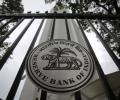
The deadline for officers to decide on their career path in the biggest organisational rejig in the central bank's 85-year history ends on January 31. The immediate fallout could be its disruptive impact on the supervisory process for 2020 -- and beyond -- given the manpower shortfall, even as more entities are set to come under closer central bank scrutiny.
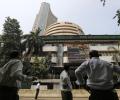
The broader 50-issue NSE Nifty too slipped from its record high, shedding 10.30 points or 0.09 per cent to end at 11,346.20.
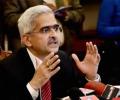
Reserve Bank Governor Shaktikanta Das has pitched for policy support from all sides -- fiscal, monetary and sectoral -- to nurture recovery of the economy hit by the second wave of the coronavirus pandemic. The dent on economic activity due to the second wave of the pandemic during April-May necessitated continuation of monetary measures to support the process of economic recovery to make it durable, Das had said while participating in the meeting of the Monetary Policy Committee (MPC) earlier in the month. "Overall, the second wave of COVID-19 has altered the near-term outlook, and policy support from all sides - fiscal, monetary and sectoral - is required to nurture recovery and expedite return to normalcy," Das said, as per the minutes of the meeting released on Friday.

The six-member monetary policy committee voted 5:1 for the decision, with only Ravindra Dholakia voting for a 0.25 per cent reduction in rates.

RBI said inflation in the second half of the current fiscal is projected at 2.7-3.2%. It retained its GDP forecast for the current fiscal at 7.4%

Analysts at Bank of America Merill Lynch said that fears of inflation getting "generalised" are overdone, as only two sub-categories of fuel and light and housing (accounting for 22 per cent of the basket) have seen a price-rise above the headline 5.2 per cent.
.jpg)
Food and fuel inflation in India have remained high for several years, the paper said, adding to durably reduce the current high inflation, the monetary policy stance needs to remain tight for a considerable length of time.

A combination of farm loan debt waivers by state governments and the implementation of the pay commission award could entail some fiscal slippages and pose a risk to inflation

Reserve Bank of India Governor Shaktikanta Das on Friday said the country's economy is an island of stability despite two Black Swan events and multiple shocks. "In an ocean of high turbulence and uncertainty, Indian economy is an island of macroeconomic and financial stability," Das told reporters during the post policy press conference. He said the financial stability, macroeconomic stability and resilience of growth is being witnessed despite two Black Swan events happening one after the other and multiple shocks.
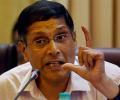
Progress on the steps taken by Governor Shaktikanta Das' predecessor Urjit Patel to restore financial system integrity will be a key thing to assess any damage to the institution, Subramanian said.

Kumar said that while the rise in percentage of population of the deprived castes has led to increase in the quotas for SCs, STs and OBCs from 50 to 65 per cent, his government also planned to undertake a number of welfare measures for the benefit of "94 lakh families", which according to the survey lived in abject poverty.
The Jalan panel has recommended to the RBI to keep shady entities out of banking licence race.

As he projected a grim outlook for the economy, RBI Governor said that amidst this encircling gloom, agriculture and allied activities have provided a beacon of hope on the back of an increase of 3.7 per cent in foodgrains production to a new record.

Retail inflation declined to a one-year low of 5.72 per cent in December 2022, mainly due to softening prices of food items, according to official data released on Thursday. The Consumer Price Index (CPI) based retail inflation was at 5.88 per cent in November 2022 and 5.66 per cent in December 2021.
For July-September, it pegged CPI-based retail inflation at 4.2 per cent which it saw firming up to 4.8 per cent in the second half of the current fiscal.

The committee headed by RBI's Deputy Governor Usha Thorat made a series of recommendations that include increasing banking penetration and strengthening of Regional Rural banks and Urban Co-operative banks in the region. It said post offices, traditional institutions and NGOs need to be co-opted by the banking industry so as to encourage economic activities.

Terming the RBI action on Wednesday as a "pleasant surprise", analysts today cautioned that possibility of a rate hike in the future cannot be ruled out. Urijit Patel committee's report on monetary policy would clear the air on RBI's future stand, they added.

The policy review observed that the moderation in inflation, excluding food and fuel, that was witnessed in the first quarter of 2017-18 has "by and large, reversed".

'Normally, the system is geared towards counting notes -- it is equipped to do x amount of work and one day you are asking them to do 20 x.' 'The processes involved are very complex.'

The SEBI and the RBI will look into it. Let their reports come in, BJP MP Mahesh Jethmalani said.

Reserve Bank of India (RBI) Executive Director Anand Sinha is set to replace Usha Thorat as deputy governor. Finance Minister Pranab Mukherjee has recommended Sinha's candidature to the Appointments Committee of the Cabinet (ACC).

The Governor said the MPC had voted to maintain its accommodative stance, implying more rate cuts in the future if the need arises.

This is contrary to the expectations of a majority of analysts predicting for another hike given the rise in inflation lately, including domestic ratings agency Icra

The RBI now brings in important and contentious changes directly through voluminous Master Directions, or Master Circulars

The Reserve Bank on Wednesday retained the GDP growth forecast at 9.5 per cent for the current fiscal but cautioned that the economic recovery is not yet strong enough to be self-sustaining and durable.

Retail inflation crossed the RBI's comfort level and rose to 5.21 per cent in December on increase in prices of food items.

Manufacturing activities in India fell to a five-month low in September as new orders rose at a softer pace, which tempered production growth, a monthly survey said on Tuesday. The seasonally adjusted S&P Global India Manufacturing Purchasing Managers' Index (PMI) fell to 57.5 in September, down from 58.6 in August -- the lowest in five months. The September PMI data pointed to an improvement in overall operating conditions for the 27th straight month.

The repo rate, at which the central bank lends short-term money to other banks, will continue to stay at 6 per cent.
Not only were Urjit and Rajan outsiders, they also hired laterally, bypassing the existing talent, especially in the field of economics


A Reserve Bank panel has decided against the inclusion of any other national leader's image on banknotes saying that no other personality could better represent the ethos of India than Mahatma Gandhi.
Demonetisation to result in short-run disruptions in cash-intensive sectors like retail, hotels, restaurants and transportation, RBI said while announcing the Monetary Policy

RBI wants periodic revision of the pensions for its retired employees.

'They can transition from short to long-duration funds when the yield curve normalises.'

The Financial Inclusion Advisory Committee under RBI Deputy Governor K C Chakrabarty is expected to suggest appropriate regulatory framework to ensure that financial inclusion and financial stability move in tandem, the RBI said in a statement.
The imported inflation component is also expected to ebb on lower oil prices and softer US dollar, it said.

The insolvency process of debt-ridden Reliance Capital Ltd (RCL) on Tuesday hit a roadblock as the NCLT Mumbai has stayed the resolution process on the plea of Torrent Group. The stay order was issued by the National Company Law Tribunal (NCLT) as the Ahmedabad-based Torrent Group challenged the revised bid from Hinduja Group, sources said. Torrent Group, which emerged as the highest bidder with an Rs 8,640 crore offer, had moved the NCLT-Mumbai against Hinduja Group's late revised bid, which it had submitted after the completion of the e-auction process on December 21.
The windfall from RBI may be used to trim borrowing, help fund Rs 3.3 lakh crore capex plan, capitalise banks and provide fiscal stimulus to some stressed sectors, experts and economists said.
The SBI report ruled out a October rate hike
 © 2026 Rediff.com - Advertise with us - Disclaimer - Privacy Policy - Sitemap - Feedback - About us - Terms of use - Grievances